

Installation guide
Installation Instructions

The full sequence in under 40 seconds. The written steps below have the detail.
-
What you need
- Tape measure, pencil, level and chalk line
- A saw — hand saw, circular saw or table saw all work. A fine-tooth blade, around 80 teeth or more, gives the cleanest edge on polyurethane.
- Drill or driver, and screws suited to the substrate
- Caulking gun
- Safety glasses, gloves, hearing and dust protection — and follow the tool manufacturer's instructions. A table saw does not care what you are cutting.
- Filler and a Tritan BP touch-up kit for cut edges and fastener holes
-
Storage of Panels not set — pick it in the Theme Editor
Step 1
Storage of Panels
- Tritan BP Siding should be acclimated for 24 hours prior to installation. If the siding panels have been stored in a cool climate or at room temperature, they can be installed immediately.
- Siding panels should be stored flat to prevent bowing. If in the unlikely event bowing occurs, place the panels flat and they will self-correct.
-
Before you start
- Let the panels acclimatize flat in the room for 24 hours. If they have been stored at the same temperature already, go ahead.
- Dry fit from several boxes at once. Pigments are applied by hand, so there is natural variation — mixing boxes distributes it instead of leaving a visible band.
- Prepare the wall. Clean, flat, dry and structurally sound. Remove loose paint, wallpaper, grease and any coating that stops adhesion.
- Fix moisture problems first. Do not cover an active leak. The panel will not stop it and you will be taking the wall down again.
-
The mistake that causes most of the trouble
Your house is not level. Start as if it is and the whole wall goes wrong.
Floors settle. Slabs slope. If you lay the first row along the floor and trust it, every row above inherits that error and it compounds — by the top of the wall the joints are visibly off and the panels no longer interlock cleanly.
Strike a level line for the first row. Do not measure up from the floor. Where the floor or base is uneven, sand or trim the bottom edge of the panels so the tops sit on that level line. Check it, then check it again before any adhesive comes out.
Once the first row is level and straight, everything above it is easy. That row is most of the skill in the job.
-
Step 2
Installing Faux Siding
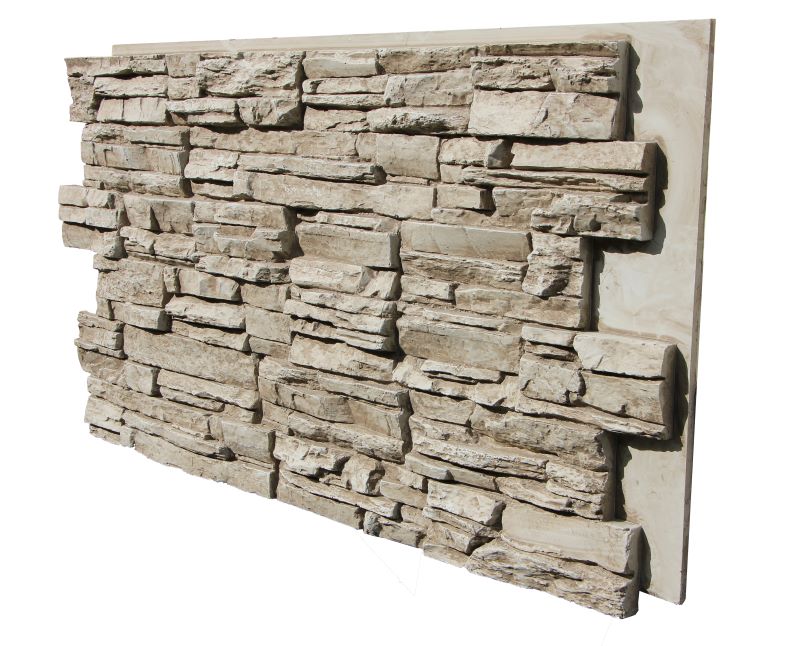
- The top of the panel has a protruding lip that will fit behind the panel that is being stacked on top.
- Due to the panels being highly textured, it is recommended that all measurements be marked and cut on the flat backside o the panel.
- Tritan BP Siding panels interlock at each end and along the top/bottom. This helps to provide a virtually seamless look. In many cases, the first panel must have one side of the "fingers" trimmed off to create a straight edge.
- Panels should be installed onto a clean flat dry surface.
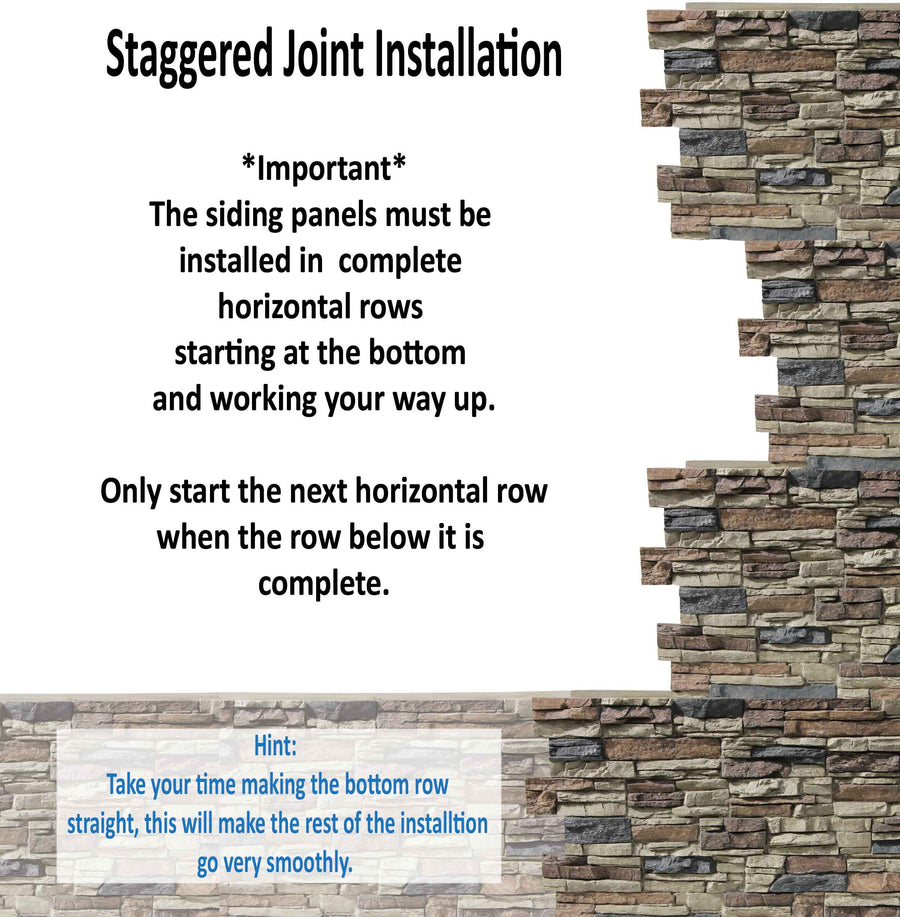
- The faux siding should be installed from the bottom corner in a straight line. Each panel should be pressed firmly and tightly against one another for best results. It is very important that the first row of panels be installed level and straight for best outcomes. Always install the panels in full rows working your way up. The horizontal row must be installed before going vertically up. If the floor is not perfectly straight, the bottom of the panel may need to be slightly trimmed to ensure a straight and level installation.
- When installing the siding, we recommend staggering the first panel. As shown in the image here.
-
Step 3
Adhesive and fasteners
Use a liberal amount of construction adhesive, and run it around the entire perimeter of the panel — not just a few dabs in the middle. Vertical beads across the back, then adhesive all the way round the edges.
Especially behind every point where panels interlock, including each protruding finger that overlaps the next panel. That is not just mechanical grip: the adhesive forms a chemical bond between the two interlocking panels, so the wall behaves as one piece rather than a set of separate tiles.
Skimp there and you get joints that open up later.
We recommend PL Premium, or another polyurethane-compatible high-strength construction adhesive. For larger installations, Enerfoam or Great Stuff work well and cover far more panels per can.
We do not recommend Liquid Nails.
- Press the panel firmly onto the mounting surface and screw the panel into place — we recommend construction adhesive and screws together.
- We recommend using TapCon Screws if installing onto concrete block.
- Screw / Nails should be installed along the tongue along with other unnoticeable places. If you need to further conceal a hole, simply apply a little wood filler to the screw hole and once dry, apply a little touch up stain.
- Once the first panel is in place, repeat the processes above ensuring that each panel fits tightly and straight against one another.
- Panels can be mitered on a table saw, we recommend using a blade with 80 teeth or greater when using a circular saw to but the panels.
- Accessories such as, ledge trims, outlets and outside corners, outlet covers and more, make for an easy installation.
- Approximate adhesive needed - 4 Panels = 1 Tube of PL Premium
-
Laying the rows
- Dry fit the panel — position, interlock and cuts — before opening the adhesive.
- Apply adhesive as described above: vertical beads, full perimeter, behind every interlocking finger.
- Set the panel firmly against the wall and slide it slightly into the neighboring panel so the joint closes tight.
- Fix it through the fingers and tongue.
- Finish the row before starting the one above.
Stagger the vertical joints row to row, like brickwork. Aligned joints running up the wall are the giveaway that something was installed in a hurry.
Mark measurements on the flat back of the panel, and keep usable leftover pieces to start later rows — but only where the interlock still faces the right way.
-
Corners, outlets and edges
- Use universal outside corners and matching trim where the wall turns.
- Inside corners can be mitered. Keep the joint tight, fill any gap and finish with the touch-up kit.
- Isolate the power before cutting around an outlet or switch. Use a licensed electrician where required.
- Do not cover vents, drainage paths, movement joints or access panels.
-
Outdoors and near heat
Exterior walls need the supporting structure, membranes, flashings and sealants detailed for the building. Panels are not a weather-resisting layer — they go over one.
Around fireplaces, stoves and ranges, follow the appliance manufacturer's clearances and local code. Class A fire rating does not change a required clearance. What Class A actually means →
If there is any doubt, call us before fitting.
-
Caulking brick panels not set — pick it in the Theme Editor
Step 4
Caulking brick panels
For brick panels we recommend caulking the joints once the panels are up — it hides the seams and gives a cleaner finished wall. British Brick and Aged Brick each have a matching color caulk; plan on about 1 tube per 8 panels. Cottage Lane has no matching caulk yet: use a little wood filler at the connection points, or a paintable caulk, blended with a matching touch-up paint.
-
Step 5
Touch Up Instructions
- If needed, fill screw/nail holes, miter joints or other openings with wood filler or Bondo. Allow for the wood filler or Bondo to completely dry before moving to the next step.
- The color of your panels will determine the number of touch-up bottles you receive in the touch up kit. Some of the paint bottles received may not be needed during your repair.
- To achieve a proper color match, ensure that the paint container lids are sealed and shake thoroughly.
- Using a brush, apply the appropriate touch-up paint to the area of the panel needed to be touched up. Let it sit for 20 seconds.
- After 20 seconds, wipe lightly with a rag until you achieve the desired effect. Allow the paint to completely dry. This is a water-based paint and dry time can differ based on temperature and air flow.
Tips to keep in mind:
- Do not apply over existing paint, only area that needs to be touched up as this can cause the area to darken.
- Make sure your brush is clean and dry when switching between different paints to avoid contamination.
-
Finishing check
- Every row level, every joint tight
- Each panel fixed into sound backing, sitting flat, not crushed
- Squeeze-out removed by a method the adhesive manufacturer approves — test it on a scrap first
- Fastener holes and mitered joints filled, dry, and touched up
Now, sit back, relax and enjoy your creation!
Ready to start?
Work out how many panels you need, then pick a color.